Car Affordability Calculator
Start from the monthly payment you can actually carry — get the car price that fits, with tax and down payment factored in.
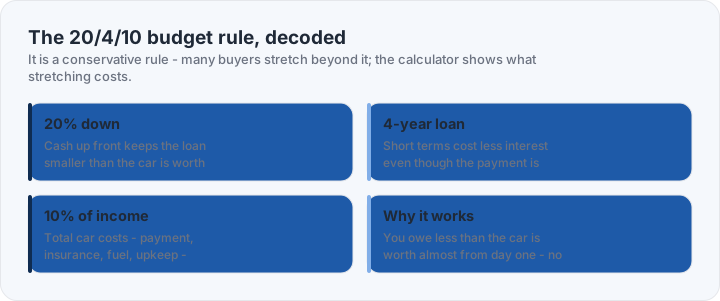
Budget rule of thumb: keep the total cost of ownership — payment plus insurance, fuel and upkeep — under about 10% of gross income.
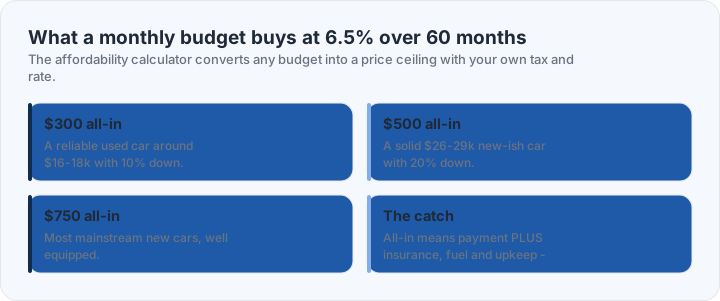
Most people shop cars forward: fall for a car, then ask what the payment will be. That order is exactly how payment-myopia happens at the dealership, where a friendly monthly number can hide an 84-month loan. This calculator runs the math backwards — you declare the payment, and it tells you the price of car that payment actually buys.
Two honest adjustments to make before you trust the output. First, the payment is not the cost: insurance on a new car, fuel, registration and upkeep typically add 30-50% on top. If $500 fits your budget as an all-in number, enter roughly $330-380 as the payment and let the rest live in running costs. Second, remember the trade-in you will eventually have — buyers who keep cars 8+ years get far more value per dollar than serial leasers, and the affordability ceiling should reflect that plan, not the showroom high.
The 20/4/10 rule in the chart below is the conservative classic: 20% down, a loan no longer than four years, and total car costs under 10% of gross income. Break any of the three and the numbers here will show you exactly what the stretch costs — sometimes it is worth it, but it should be a decision, not a surprise.
Frequently asked questions
How much car can I afford on my salary?
A common ceiling is total car costs at 10% of gross income — about a $400-450 all-in budget on a $60,000 salary. The calculator turns whatever budget you choose into a price ceiling including tax and down payment.
Does this include insurance and fuel?
No — enter a payment budget that leaves room for them, or run the output and add roughly 30-50% for running costs on a newer car.
What if I have no down payment?
Set the down payment to zero — you will see the affordable price drop, which is the honest cost of financing 100% of the car.
Is the 20/4/10 rule realistic in 2026?
It is deliberately conservative — average new-car loans run 68-72 months, far past the rule 48-month ceiling. Use it as a compass rather than a law: the further you stretch from it, the more the interest column in the calculator matters.
Should I finance through the dealer or a bank?
Get both numbers. Dealer-arranged financing is convenient and sometimes carries subvented (manufacturer-subsidized) rates that genuinely beat banks — but compare the APR against a credit-union pre-approval before signing. The pre-approval is your ceiling; subvented rates are the dealer's reason to beat it.