Car Down Payment Calculator & Guide
How much down is enough — with the payment, interest and equity effects quantified.
Type a different down payment and watch the payment, total and interest move — the trade-off in front of you, quantified.
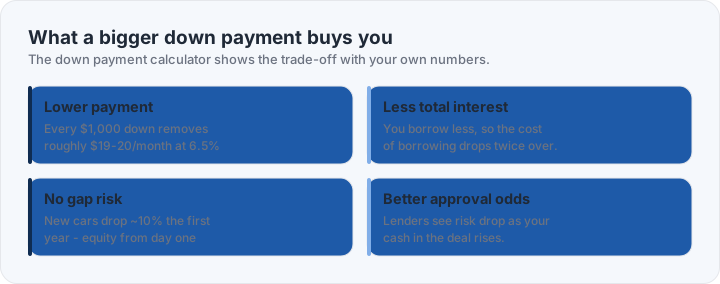
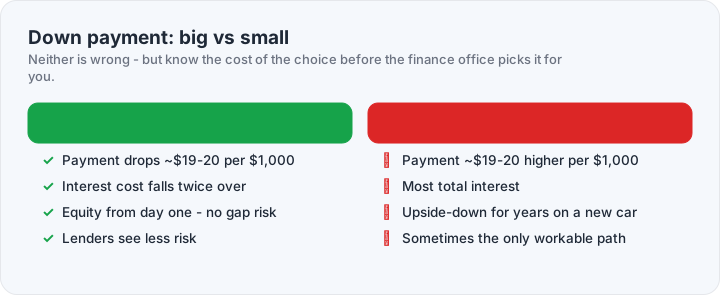
The classic rule — 20% down on a car — is not financial superstition; it is arithmetic about how cars lose value. A new car typically drops around 10% of its value in the first year. Put 20% down and you start with equity deeper than that drop; put zero down and you owe more than the car is worth from the drive-home, sometimes for years. That gap is what makes zero-down owners miserable if the car is totaled or life forces a sale.
The payment arithmetic is gentler than people expect — roughly $19-20 per month less per $1,000 down at 6.5% over 60 months — but the interest arithmetic is not: the same $1,000 also removes itself from the principal that every later payment's interest compounds against. And lenders see cash in the deal as risk off their books, which quietly improves both approval odds and sometimes the rate itself.
When is less down acceptable? If the car is cheap relative to your income, if you have a strong trade-in doing the same job, or if the alternative is draining an emergency fund — never drain the emergency fund for a down payment. The 20% number is a target for new cars; on inexpensive used cars, 10% plus a short term often tells the same story.
Frequently asked questions
How much should I put down on a $30,000 car?
The classic answer: 20% — $6,000 — keeps you ahead of first-year depreciation. At 6.5% over 60 months, each $1,000 of that moves the payment by roughly $19-20.
Is zero down ever OK?
On a cheap used car with a short term, or with a large trade-in doing the work — zero-down on a new car is the combination that produces the most upside-down loans.
Should I use my trade-in instead of cash?
They do the same job mathematically. Trade equity is often the easier path — just confirm the dealer's trade offer against private-sale value first (see our trade-in guide).
What if I can only manage 10% down?
Then 10% plus a shorter term tells a similar story: the goal is staying ahead of depreciation, and a 48-month loan on a reliable used car at 10% down does that. Run both scenarios above — the payment gap is usually smaller than people fear, while the interest gap is bigger.
Is gap insurance part of the down payment?
No — gap coverage is separate, usually rolled into the loan. It is worth having while you are upside-down (which a healthy down payment largely prevents) and worth canceling once the balance drops below the value.